


Measuring Fermentation: Gravity, Brix, Plato, and What They Tell You
At this point in the Homebrew Skills Tree, we are still working near the roots. These early skills are simple, but they give brewers something very important: confidence and visibility.
So far we have focused on foundational habits like cleaning and sanitizing and understanding water chemistry issues such as chlorine and chloramine. Now we add another essential skill: measuring fermentation.
Many new brewers rely on visual signs such as bubbles in the airlock or foam on the surface. Those can be helpful clues, but they are not always reliable. A simple measurement tool can tell you something much more useful: how much sugar is present in the liquid and how fermentation is progressing.
Why Measuring Matters
Fermentation is the process where yeast converts sugar into alcohol and carbon dioxide. When fermentation begins, the liquid contains a lot of sugar. As yeast consumes that sugar, the amount decreases. If you can measure the sugar level, you can answer several important questions:
- Did fermentation actually start?
- How fast is it progressing?
- Is fermentation finished?
- Did fermentation stop early?
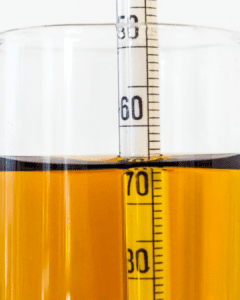
These questions are difficult to answer by sight alone. But they become easy when you track fermentation with tools such as a hydrometer or refractometer. A hydrometer is a weighted glass tube that is calibrated to pure water. When you put it in wort, the density of the sugar causes the hydrometer to float higher in the liquid, so you can read the density measurement on the side of the tube. A refractometer is also calibrated to pure water, but uses light refraction through the sample to determine density that can be viewed through a lens.
Different Ways to Measure Sugar
Several scales are used to measure sugar content in brewing and fermentation. Although they look different, they all describe the same basic idea: how much dissolved sugar is in the liquid.
Specific Gravity (SG)
Specific gravity compares the density of a liquid to the density of water. Pure water has a specific gravity of 1.000. A sugar-rich liquid such as wort, must, or juice will have a higher number, for example: 1.050, 1.080, or 1.110, representing relatively more density than plain water. Sometimes, homebrewers might refer to 1.050 as ten-fifty or 50 points, 1.080 would be ten-eighty or 80 points, etc.
Most of this density could be sugar, but perhaps some other ingredients from the mash or boil, etc. The important part is that if you know what the density was when you started, and you know what it is now, and the sugar content is the only thing that’s changed due to the yeast doing their fermenting thing, you know how much sugar has been consumed!
Specific gravity is the scale most commonly used with a hydrometer by homebrewers.
Degrees Plato (°P)
Plato measures the percentage of sugar by weight in a liquid. For example, 12° Plato means roughly 12% sugar by weight. To convert specific gravity to plato, divide the SG points by 4, eg 1.048 is 48 points, divided by 4 equals 12P. So 1.048 and 12P are [about] the same.
Many commercial breweries prefer Plato because it connects easily with brewing calculations.
Brix
Brix is very similar to Plato and is widely used in winemaking and fruit fermentation. One degree Brix corresponds to approximately 1 gram of sugar per 100 grams of liquid. Brix measurements are often taken using a refractometer, which uses light to estimate sugar concentration.
Why Brewers Track Fermentation
Most brewers measure at least two points during fermentation:
Original Gravity (OG) – The sugar concentration before fermentation begins.
Final Gravity (FG) – The sugar concentration after fermentation finishes.
Knowing these two numbers helps brewers understand several things:
- how completely the yeast fermented the sugars
- the approximate alcohol content
- whether fermentation finished normally
But even more importantly, intermediate measurements tell you what is happening right now. For example, if a batch starts at 1.080 and drops to 1.030 after several days, fermentation is clearly underway. Without measurements, a brewer might worry that the yeast failed or fermentation stalled.
When Fermentation Seems Stuck
Sometimes fermentation slows earlier than expected. Before assuming there is a problem, check the gravity with a hydrometer or refractometer. The yeast may simply be nearing the end of its normal activity. Your recipe should have an expected final gravity number. If you measure it today and it’s 1.021, and you measure it again tomorrow and it’s 1.019, fermentation is still going (albeit slowly).
If fermentation truly stops too early, brewers sometimes try a few gentle interventions:
- Swirling or agitating the fermenter to resuspend yeast
- Raising fermentation temperature slightly
- Adding a small amount of oxygen early in fermentation (careful! adding oxygen at the end of fermentation could lead to oxidation later)
- Pitching fresh yeast
The right approach depends on the beverage being fermented and how far along the process is.
Measuring Sweetness in Mead and Cider
For mead and cider makers, gravity measurements are especially useful because they help control sweetness. If a brewer prefers a sweeter finish, they might stop fermentation earlier by stabilizing the beverage with potassium sorbate, often combined with Campden tablets. Once fermentation is stabilized with potassium sorbate, it becomes safe to add additional sweetness through honey, fruit juice, sugar, etc.
Without gravity measurements, it would be difficult to know exactly how sweet the beverage is or when the fermentation has finished.
A Simple Tool That Builds Confidence
One of the most common concerns among new brewers is uncertainty.
- “Did my yeast start working?”
- “Is fermentation finished?”
- “Should I bottle now?”
A simple gravity measurement with a hydrometer or refractometer can answer all three questions!
This is why measuring fermentation sits near the roots of the Homebrew Skills Tree. It is not complicated, but it gives brewers a window into what is happening inside the fermenter. As your skills grow and you move higher up the tree, measurements like these become valuable tools for refining recipes, improving consistency, and experimenting with new fermentation styles. But it all begins with learning how to measure and observe the fermentation process itself.
Where Are You on the Homebrew Skills Tree?
The trunk is beginning to grow. You’re no longer relying on bubbling airlocks or guesswork .. you can now measure what your fermentation is actually doing.
You’ve learned how to:
- Measure gravity and sugar content
- Track fermentation progress
- Know when fermentation has started—and when it’s truly finished
Next week: We’ll explore why oxygen is one of yeast’s greatest friends…until it becomes one of beer’s greatest enemies. Check out the rest of the stories on our Homebrew Skills Tree!
Here are some links to our fermentation-related measuring tools and ingredients.
Hydrometers & Refractometers Potassium Sorbate Campden Tablets
Cheers!
Grain Honey Yeast SCOBYs Hops Nutrients Flavorings Fermenters Equipment Kits
Science Sidebar: Why Alcohol Changes Density
One reason brewers measure fermentation with a hydrometer or refractometer is because fermentation changes the density of the liquid.
At the start of fermentation, wort, must, or juice contains a lot of dissolved sugar. Sugar molecules make the liquid heavier and more dense than water. That is why the specific gravity reading is higher than 1.000. During fermentation, yeast converts sugar into two main products: alcohol and carbon dioxide. Carbon dioxide escapes as gas, which is why we see bubbling in the airlock. Alcohol, however, stays in the liquid. And alcohol is less dense than water.
So during fermentation, two things happen at the same time: Sugar (which makes the liquid heavier) is removed; and Alcohol (which is lighter than water) is added. Both of these changes cause the density of the liquid to drop. That is why gravity readings steadily decrease during fermentation. For example, a beer might start around 1.050 and finish near 1.010. A mead might start around 1.100 and finish closer to 1.000 or even lower.
By watching how the gravity changes over time, brewers can see how fermentation is progressing, even though the yeast itself is too small to be seen. It is a simple measurement, but it reveals a lot about what is happening inside the fermenter.