
 Big Flavor. Small Batch. No Garage Required.
 Big Flavor. Small Batch. No Garage Required.
You do not need a garage full of equipment to make great beer. This recipe is designed for brewers with limited space and a busy schedule. Everything can be brewed on a kitchen stove using equipment that fits in a cabinet, and the finished beer fits comfortably in a one-gallon fermenter. It’s a perfect first all-grain batch, a fun weekend project, or an easy way to experiment with new ingredients without committing to five gallons. And, you’ll be enjoying it in the summer Texas heat in about 2-3 weeks! Fun fact, kveik is a great yeast for mead too 😉
Equipment
You’ll need only a few pieces of equipment:
- 2–3 gallon kettle (inexpensive at a discount or big box grocery store, or an existing stew or deep fryer pot)
- 1-gallon fermentation bucket or jug
- Medium-sized grain bag
- Airlock
- Hydrometer
- Thermometer
- Star San
- Auto siphon
- Bottles and bottle capper (or a small keg if you have one)
- Bottling sugar
- Yeast nutrient (eg, any brand of nitrogen, DAP, servomyces, etc)
- A campden tablet
That’s it. Everything fits in a kitchen cabinet when you’re done.
Grain Bill
- 2.0 lb US 2-Row Pale Malt
- 0.25 lb Vienna Malt
- 0.10 lb Carapils
Target specs:
- Starting gravity: 1.048
- Target final gravity: 1.009
- ABV: ~5%
Mash
Heat water in the pot to 150°F. Break up the campden tablet and put in the water (this helps sanitize the water and also helps your beer not smell like chlorine!).
Steep the milled grain in the grain bag for 60 minutes. When done, lift the grain bag, let it drain, and begin the boil.
Boil and Hops
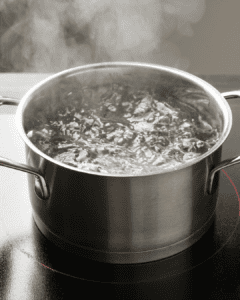
Start a 60-minute countdown timer when the wort starts boiling.
At this 60 minute mark, add 0.10 oz Magnum
When 15 minutes are left, add 0.20 oz of Cascade and 0.10 oz of Citra
When the 60 minutes are up, turn off the heat (flameout), and add the additional 0.25 oz of Cascade and 0.25 oz of Citra.
No dry hopping necessary. The late additions provide plenty of citrus aroma without adding another step.
Once the boil is complete (60 minutes gone by), cool the pot down with an ice bath in a sink or large tub (knockout). When the wort is cooled down to about 70°F, it’s time to pitch the yeast.
Yeast
Sanitize the fermenter (bucket or jar) with StarSan or SaniClean for a few minutes, then pour the sanitizer back into the sanitizer bucket. These products do not require rinsing, and any residual foam is perfectly fine to leave in the fermenter (there’s a saying, “don’t fear the foam”. Pour the wort from the kettle into the fermenting bucket. Oxygen at this point is great for the yeast, so feel free to pour hard to make bubbles and foam. If you’re moving the beer from the kettle into a jar or bottle, siphon or funnel the wort into the glass jar, then shake it vigorously to get some foam going.
One packet of Lallemand Voss Kveik is designed to ferment five-gallon batches. For this recipe, pitch approximately 2–3 grams of dry yeast, or save a small amount from a previous batch. Kveik performs great between 75–95°F … perfect for in the house, even in the summer time! Unlike many traditional ale strains, it remains remarkably clean over a wide temperature range, making it forgiving for apartment brewers without dedicated fermentation temperature control.
Add a pinch of yeast nutrient, put the lid on the fermenter, and put a small amount of water in the airlock to let CO2 out without letting bacteria or wild yeast in!
Fermentation
Place the fermenter in the coolest room of your apartment. Even if the room is in the mid-70s, Kveik will generally produce a clean, refreshing pale ale.
Primary fermentation is often complete within 4–5 days, though giving it another week to mature will produce a cleaner beer.
Bottling
When the fermentation is done (based on the gravity you’ll read with the hydrometer), it’s time to bottle. One gallon of beer will require about 10 12oz bottles. After sanitizing the bottles, add 2 grams of bottling sugar (dextrose, corn sugar) to each bottle, or use pre-made carbonation drops. Gently move the beer from the fermenter to the bottles. Oxygen at this point is bad, so you want to be as quiet and gentle with it as possible so not to inject oxygen into the beer.
Sanitize the bottle lids, and use the capper to lock them down. Allow bottles to carbonate for about two weeks. Chill and enjoy!
What You’ll Taste
You should expect a bright citrus aroma, light malt character, crisp finish, refreshing body, and subtle orange notes from the Kveik yeast .. perfect after mowing the lawn, grilling dinner, or relaxing on the patio after work.
Why Small Batches?
One-gallon brewing has become increasingly popular because it removes many of the barriers that discourage new brewers. Small batches mean less equipment, lower ingredient cost, easier cleanup, faster experimentation, and room to try new styles without filling a keg or dozens of bottles. It’s also a great way to learn all-grain brewing before scaling up to larger systems. This recipe can also be done with about 1lb of DME or LME instead of the two-row, so you’ll only have to steep the vienna and carapils, then add the DME/LME in the last ten minutes of the boil!
Building Skills Through Simplicity
One of the goals of the Homebrew Skills Tree is showing that great brewing isn’t about having the biggest brewery .. it is 100% about understanding the process. A one-gallon batch teaches the same skills as a ten-gallon batch, ie water chemistry, mash temperature, hop timing, sanitation, yeast health, and fermentation control. The equipment may be smaller, but the science is exactly the same, and it’s way easier to experiment with yeast and hops on a much more frequent basis.
Whether you’re brewing in an apartment kitchen or a dedicated home brewery, every batch is another opportunity to build your skills and enjoy the process!
I hope you have fun with this one and come up with something tasty and light.
Reply here and let us know how it turns out!
Check out our starter homebrewing equipment kits here .. they have all the equipment you need to make this small batch recipe, and it’ll get you going in the right direction!
If you want to do your own recipe, we certainly have the grains and hops and yeast.
Cheers!
-eric-
Grain Honey Yeast SCOBYs Hops Nutrients Flavorings Fermenters Equipment Kits